
From Shell to Story: How a Kukudushi Is Made on Curaçao
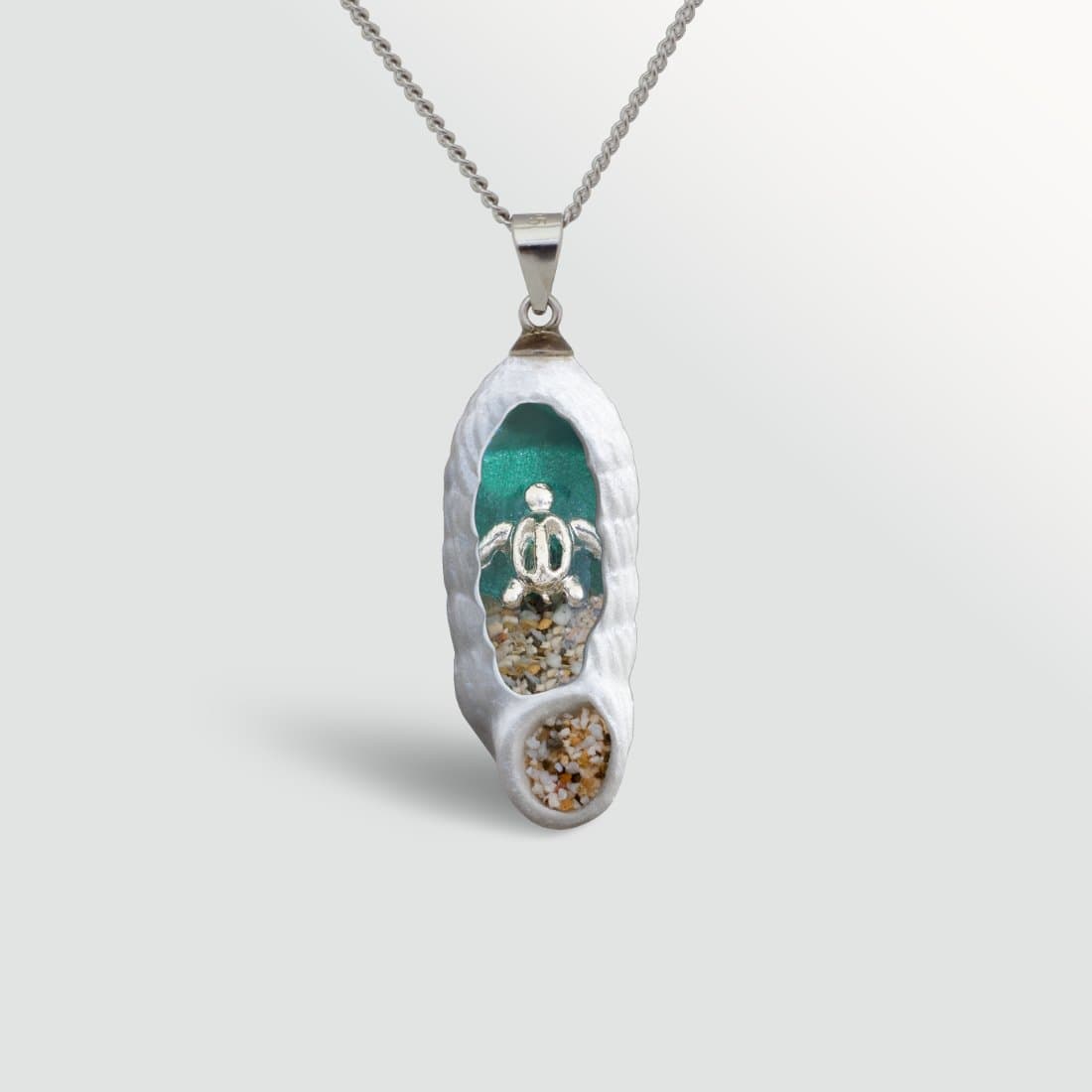
Ask us what a Kukudushi is and we can give you the short answer: handmade jewelry from Curaçao with a tiny chip inside that lets you follow a real wild animal on your phone. But the short answer skips all the good parts. It skips the little island snail that donates its home without ever knowing it. It skips the sand, scooped from the beaches we grew up on. It skips the makers who sign every piece by hand, and the reason your animal's location is always a day behind. So here is the long answer, the full journey of how a Kukudushi is made, from shell to story.
It starts with a shell nobody had to give up
The heart of a classic Kukudushi pendant is the shell of the Kokolishi di Kalakuna, a land snail found only in the Caribbean. You will not find this shell on most of the world’s coasts, which feels like a fitting start for a piece of jewelry meant to hold a memory of this island.
Just as important is how we get them. Every shell we use has been naturally shed by its inhabitant. The snail moves on, the shell stays behind, and we give it a second life. No animal is harmed, collected, or disturbed to make a Kukudushi. For a brand built around protecting wildlife, that is not a nice-to-have. It is the only way we would ever do it.
A little piece of Curaçao, sealed inside
Look closely at a pendant like our Warana and you will see it is not empty. Inside the shell we place a small scene, built from a few carefully chosen elements:
- A mini sea turtle or a mini dolphin, a tiny companion resting inside the shell.
- A ball of recycled plastic for our Luna design, created with Green Phenix here on Curaçao, plastic waste turned into something worth keeping.
- Real sand from local Curaçao beaches, the same sand you may have had between your toes on your last day of holiday.
That last part matters more than people expect. When customers write to us months after their trip, the sand is what they mention. It is not a picture of the beach. It is the beach.
Handmade by Local Maestros, signed on the back
There is no production line at Kukudushi. Every piece is assembled by hand by our Local Maestros, the makers here on the island who shape, fill, and finish each shell one at a time. Turn your Kukudushi over and you will find the mastersign on the back, the personal mark of the person who made it. On our website you can even see who your maker is.
We are also proud that our products are partly created by individuals who face barriers to the labor market. Craftsmanship, in our view, is something you offer people, not something you gatekeep. It is one of the reasons a Kukudushi never feels like a factory souvenir.
"It's a unique souvenir combining memory, education, and design."
That line comes from the conversations we have with our retail partners, and it is the simplest way we know to describe what the Maestros put into every single piece.
The chip that turns jewelry into a window
Now for the part you cannot see. Inside every Kukudushi sits an NFC chip. Hold your jewelry against the back of your phone, no app needed, and your personal tracking page opens. From there you choose a real wild animal to follow: sea turtles, dolphins, or sharks like tiger shark Emily, real animals wearing real trackers, shown on a map on your screen.
Every Kukudushi works with every animal on the list. You pick your animal after your jewelry arrives, and you can follow more animals over time, so the piece keeps growing with you long after your trip ends.
One question we get a lot: why does my animal's location update with a delay? That is deliberate. As we explain on our instructions page:
"In order to safeguard the animals and prevent poaching, there is a 24 hour delay in updating the tracks."
Live locations of wild animals are exactly the kind of information poachers would love to have. So you see yesterday's journey instead of this minute's position, and the animal stays safe. We think that is a fair trade, and most of our customers agree the moment they hear the reason.
The impact each piece carries
Kukudushi is a social enterprise. We give a share of our revenue to local partners like BRANCH Coral Foundation and Green Phenix, the people doing the patient, unglamorous work of protecting the island and the animals our customers follow every day. The connection is direct: the jewelry helps fund the protection of the very animals it connects you to.
That is also why we believe a Kukudushi makes a different kind of gift.
"You're not just giving a necklace. You're giving hope. You're gifting connection."
A souvenir usually points backwards, at a trip that is already over. A Kukudushi points forwards, at an animal that is still out there, still swimming, still being watched over.
Your story starts here
So that is how a Kukudushi is made: a naturally shed shell from an island snail, a handful of Curaçao sand, the hands and signature of a Local Maestro, a chip that connects you to a wild animal, and an impact that continues long after checkout.
If you would like one of your own, or one for someone you love, browse the collection in our shop. Already wearing one? Our instructions page shows you how to tap, track, and adopt your first animal.
And if anything in this story raised a question, just ask. We answer everything ourselves, every comment and every email, from right here in Willemstad. That is not a support policy. It is simply how a small island team does things.